
who we are
Embark on these unforgettable adventures and discover the true essence of the Abatan River!
Our Story
The Initiative of Ecotourism Development
In the early 2000s, Bohol was one of the so-called “Club 20” provinces. The “Club 20” refers to the top 20 poorest provinces in the Philippines. Hence, in 2004, the Bohol Convergence Support Initiative (BoCSI), led by Cong. Edgar M. Chatto with the active involvement of national government agencies (NGAs) with programs on poverty alleviation, was launched in Abatan.
In 2005, Cong. Edgar M. Chatto, along with the five LGUs of Maribojoc, Cortes, Antequera, Balilihan, and Catigbian, agreed to utilize the untapped assets of the Abatan River for tourism purposes. The concept was initiated by a people’s organization based in Cortes, the Abatan River Development Association (ARDA).
The primary aim of the project is to develop the Abatan River as an ecotourism destination to directly benefit the people, especially the poor, and to encourage community participation in the protection, conservation, and management of the environment. It also aims to preserve cultural heritage and develop existing resources.
The project covers 13.5 kilometers of the river, stretching from Barangay Salvador in Cortes to Kawasan Falls in Balilihan. Dagook Falls in Catigbian is also included. However, the Abatan River area experienced two major calamities, which posed challenges to the project.
To formalize the partnership, Gov. Erico B. Aumentado issued Executive Order 19 on November 18, 2005, creating the Abatan River Development Management Council (ARDMC) to give the initiative an official mandate.
The ecotourism development strategy of ARDMC focuses on supporting projects with strong environmental protection regulations and establishing village centers in the identified sites of the five towns. The Abatan River Community Life Tour is the primary activity, with the main village center in Cortes serving as the main entry point and docking area. The other four municipalities have their respective satellite village centers.
The Abatan River is being developed as one of the major eco-tourism destinations in the province by the Abatan River Development Management Council (ARDMC) through the Project Management Office (PMO), which was originally handled by PROCESS-Bohol. The ARDMC issued a resolution designating PROCESS-Bohol as the PMO. Currently, the PMO is directly managed by the ARDMC after the term of PROCESS-Bohol ended.
Through the efforts of Cong. Edgar M. Chatto, a Conceptual Tourism Plan was formulated with funding assistance from the Department of Tourism (DOT). This plan includes the construction of village centers and other support facilities through the Tourism Infrastructure and Enterprise Zone Authority (TIEZA). The Provincial Government of Bohol and the five LGUs provided their respective counterparts, while PROCESS-Bohol took the initiative to access funds from organizations such as UNDP-SGP, Seacology, and the Philippine Travel Agencies Association (PTAA), among others.
The ARDMC is currently chaired by Mayor Pureza V. Chatto, Municipal Mayor of Balilihan, with Mayor Lynn Iven P. Lim of the Municipality of Cortes serving as Vice Chair.
PRODUCTS AND SERVICES
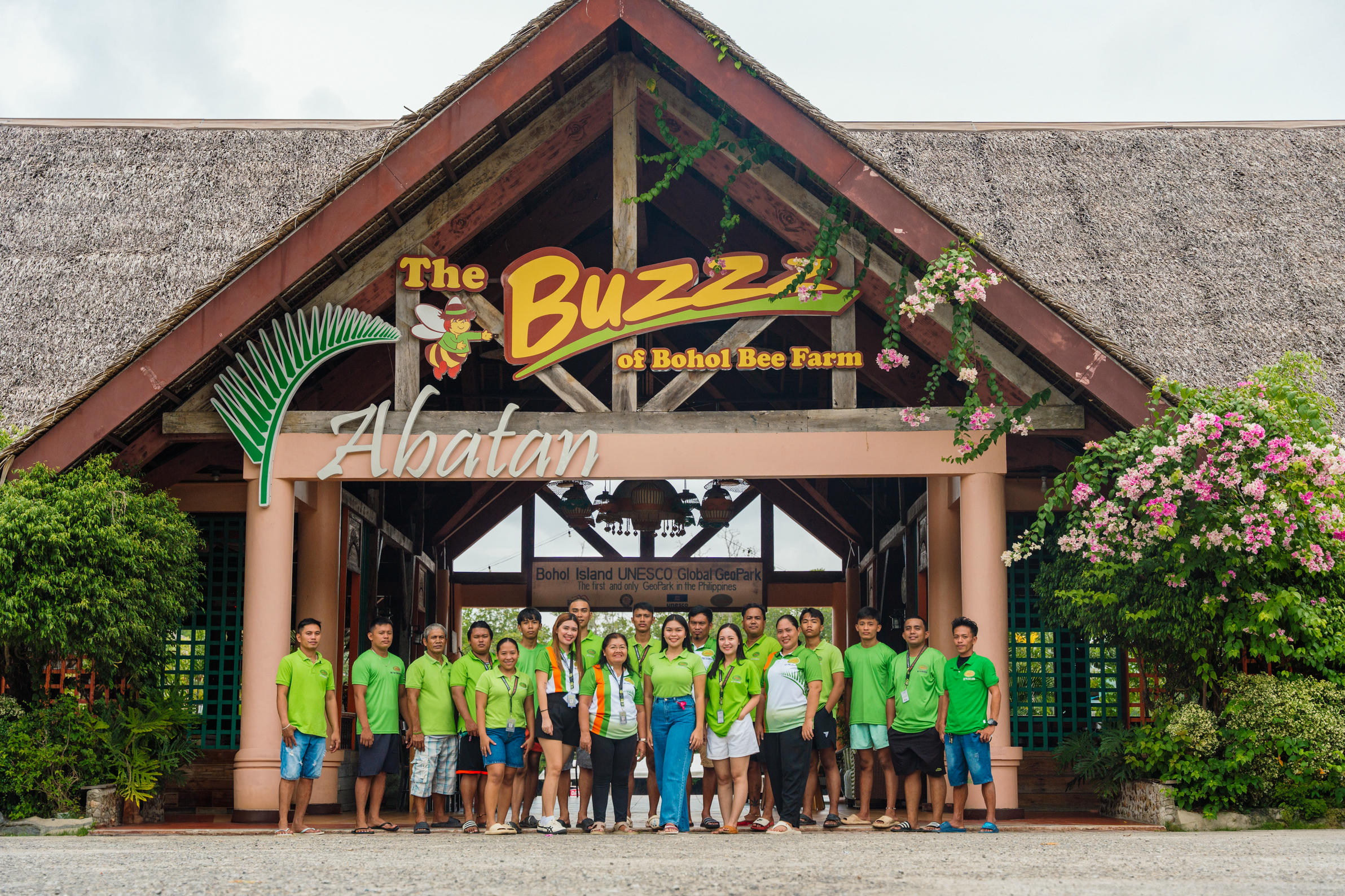
The tour products are the Abatan River Community Life Tour (packaged and flexi tours) and the Amazing Abatan Firefly Tour using bandong boat, outrigger boat and/or kayak boats. Just recently, the ARDMC entered into a partnership with The Buzzz Café and Franchising Corp. to open a restaurant at the Abatan Main Village Center. The restaurant was formally opened last April 26, 2023.
Abatan River: A Living Eco-museum
• Museum without walls
• Emphasis on the link with history, landscape, natural resources and agricultural practices with active participation of local communities
• Inclusion of Abatan River in the world eco-museum map
• The first eco-museum in the country
• Signages of mangroves and directions were installed.
EVENTS AND ACTIVITIES INVOLVED
Hosted series of local and international events
✓ The Philippine Kayaking Series 2009
– Kayak Explore Cebu-Bohol Crossing
✓ Wedding and other events
– Pre-Nup Shooting
✓ Cultural Performances of local and international cultural groups
– Hudyaka sa Abatan for local cultural groups
✓ Regular hosting of cruise ship tourists and dignitaries,
e.g. Ambassadors from Australian, Czech Republic, USA, Laos, China, Indonesia and from other Southeast Asian Countries and visitors from UNESCO being part of the Global GeoPark destinations.
✓ Regular hosting of MS Europa Cruise Ship and other cruise ship guests
✓ Regular participation in Philippine Travel Mart from 2013 -2018 and Sandugo Trade Fairs
✓ Fund accessing for facility maintenance and additional bandong boat including PMO cash investment
RESEARCH
Research on Mangroves and Fireflies in Abatan River by a former student from the Van Hall Larenstein University of Applied Sciences (VHL), Marcel J. Middeljans, a BSc Tropical Forestry and Nature Management, as his thesis.
Periodic research on the Updated Status of the Maribojoc Bay Mangrove Forest, Bohol, of which Abatan is part of it by Dr. Hilconida P. Calumpong, et al from the Institute of Environmental and Marine Sciences, Silliman University Dumaguete City.
Environmental Protection and Management
• Regular river clean up
• Mangrove monitoring and management
• Installation of signages on the creeks/channels as well as mangrove names and
communities
"Discover the Heartbeat of Nature and Culture"


Fireflies
Fireflies belong to the family Lampyridae and are members of the largest order in the insect kingdom, Coleoptera, commonly known as beetles. These insects are famous for their bioluminescence, using light signals for species recognition during mate searches. Fireflies are distributed across temperate and tropical regions worldwide, occurring on every continent except Antarctica (Lloyd, 2008).
While fireflies inhabit a variety of ecosystems, some species, particularly those of the Pteroptyx genus, are closely tied to mangrove ecosystems. These species are commonly found in Southeast Asia (Nallakumar, 2002).
The habitat, life cycle, and ecology of fireflies along the Abatan River in Bohol, Philippines, were studied by Middlejans in 2014. This six-month research was significant, as it was the first of its kind conducted in the province.
Key Findings
- The study revealed that Pteroptyx macdermotti colonies occupy a 7.8 km stretch of the Abatan River. These fireflies congregate primarily on mangrove species such as:
- Pagatpat (Sonneratia alba, Sonneratia caseolaris, Sonneratia ovata)
- Api-api (Avicennia lanata)
- Piapi (Avicennia officinalis)
- They were also observed on various other plant species.
- A total of eight (8) firefly species were identified along the Abatan River. Among them was the rare Pteroptyx macdermotti, an endemic species to the Philippines. It had not been studied since its initial description by Ballantyne and McLean in 1970.
Ecological Notes
- The larvae of fireflies are carnivorous, preying on small invertebrates.
- Adults likely survive on water and the nutrients accumulated during their larval stage.
The study highlights the ecological importance of the Abatan River’s mangroves as a habitat for fireflies, particularly the rare and endemic Pteroptyx macdermotti, emphasizing the need for conservation efforts in the region.
Life Cycle
There are four (4) different stages in the life cycle of a firefly egg, larva, pupa and adult.
• The entire larvae stage took about 4 months.
• The pupal stage lasted for only about 6-10 days.
• The adults of both male and female fireflies lived an average of 12 days, during which time, they tried to mate.
• After laying eggs, females lived another 1-2 days before they died.
Mating
Mating occurred in certain mangrove trees where P. Macdermotti fireflies congregated.
The males were waiting on leaves, flashing signals to attract females. Once a female joined a male, the male grips on top of her abdomen with the jaws of his copulation clamp and they turn in a tail-to-tail position. “The lower jaw of the clamp is the terminal abdominal sternite of the male. The upper jaw of the clamp is the male’s strongly deflexed elytral tips” (Wing et al. 1983). During the mating, the male’s hooked elytral wingtips are positioned under those of the female’s around the sixth abdominal tergite. Thus, the female vagina is swallowed by the male’s copulation clamp. Directly after mating, the females fly to the muddy riverbank to lay eggs.
Bioluminescence
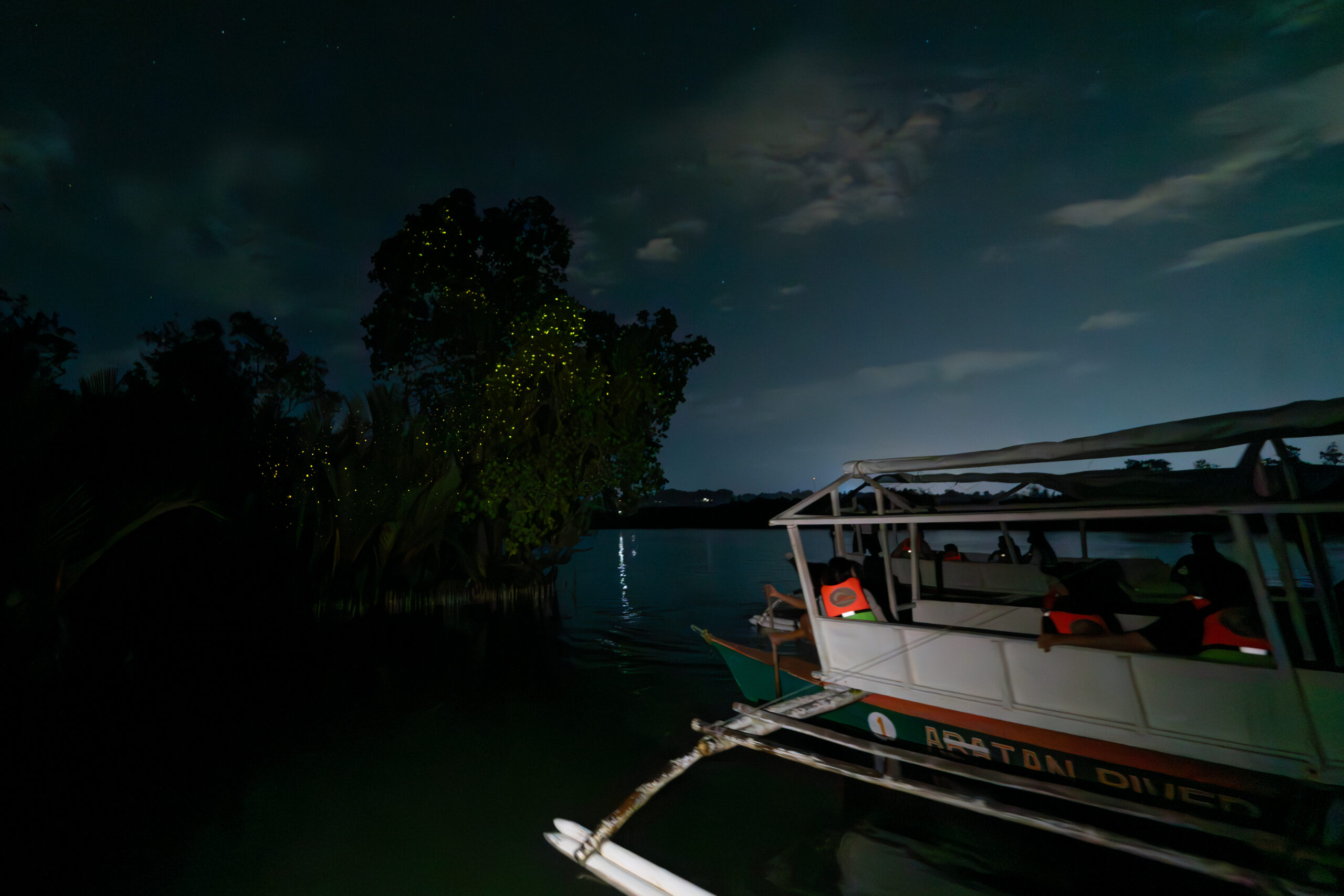
The fireflies slowly started to flash as soon as the night commenced. The number of luminescence individuals gradually increased until full luminescence was observed at around 7 o’clock in the evening. As with the starting time, the fireflies gradually stopped flashing as soon as it became dawn, around 5 o’clock in the morning. The P. Macdermotti flashes non-synchronously and the rate of their flashing is slow and bright. However, due to their high population density on some trees, it might show some synchronicity. They are certainly influenced by their neighbors. The color of luminescence is yellowish green. On the other hand, larvae do not flash but emit weak light continuously. The larvae can stop emitting light when disturbed. The eggs do not emit light at all.
The fireflies generally congregated together in the top of the trees. However, during full moon, they are seen more scattered on a bigger surface of the tree probably hiding from the moon light.
The number of flashing individuals on a tree is higher on leaves facing the river than leaves facing inland side. There was no significant difference in the firefly density between the full moon and the new moon. There was also no significant difference in the average firefly density between the different display in tree species.